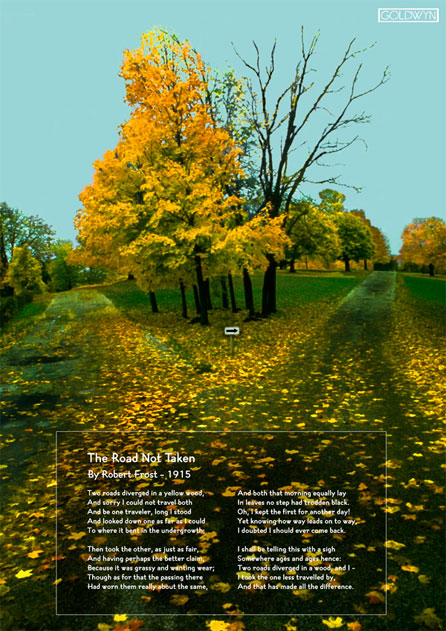
| TWO roads diverged in a yellow wood, | |
| And sorry I could not travel both | |
| And be one traveler, long I stood | |
| And looked down one as far as I could | |
| To where it bent in the undergrowth; | 5 |
| Then took the other, as just as fair, | |
| And having perhaps the better claim, | |
| Because it was grassy and wanted wear; | |
| Though as for that the passing there | |
| Had worn them really about the same, | 10 |
| And both that morning equally lay | |
| In leaves no step had trodden black. | |
| Oh, I kept the first for another day! | |
| Yet knowing how way leads on to way, | |
| I doubted if I should ever come back. | 15 |
| I shall be telling this with a sigh | |
| Somewhere ages and ages hence: | |
| Two roads diverged in a wood, and I— | |
| I took the one less traveled by, | |
| And that has made all the difference. | 20 |
WHAT DO I THINK?
REMARK:: Okay, this is my first post and I thought I ought to pick something easy and yet meaningful. At this stage of my life, if not at this stage of our lives, the road begin to diverge and to split up.
I remember this poem from Form 4. Back then we were all
Besides, everyone learnt this poem before, it would be easy for them to constructively criticize my work I will try not to regurgitate what I still remember from my Form 4 reference book and analyze it based on what i feel.
:: REMARK ENDS
STANZA 1:
Line 1 and 2 are obviously referring to the fact that the author has come to a point where he must pick one of the two journeys ahead of him.
Back then, for me this poem was just, well, a poem. It doesn't mean more than homework or exam. But today I am at the end of main road now, it is time to pick the next journey.
Line 3, 4 and 5 states that the author tries to stand on his heels and sneak a peek of the roads; to decide which one should he pick. However, like any mortals, he lacks the power to foresee the future and hence he can't see clearly where the road "bent in the undergrowth".
Don't we all are in a some sort of dilemma right now? Trying to pick the right pathway. We want to know what is at the end of the road, sadly we will never know what awaits us.
STANZA 2:
Line 6-8 refer to the other road, the other road which looks more "grassy and wanted wear".
Line 9-10 means the author, on second thought, thinks both roads are equally worn by those "travelers" who are precedent of him.
I mean, doesn't this looks familiar? Every possible roads that lay ahead of you right now, no matter how bright-future-guaranteed it is, has been taken by seniors years, if not decades, before us.
STANZA 3:
Line 11-12 refers to both roads are actually still fresh and not extremely exhausted, as no leaves are "trodden black".
Line 13-15 are the turning points of this poem. It changes from shaking and dubious uncertainty to rock-hard and firm certitude to take on the road the author believes would be the best between both. Albeit he knows he will never come back, he believes he is making the right decision.
STANZA 4:
Line 16 and 17 shifts the setting towards "ages and ages hence", somewhere the author would be telling his past with sorrow.
Line 18-20 briefly give the readers an impression of how his years have been, after taking the "less-traveled" road.
The most important line in this poem, in my opinion, is line 20.
And that has made all the difference.
The tone of this line is very neutral, neither positive and negative. The author never tells the readers what difference did it made? Is it a good one? Is it a bad one? He leaves this to the speculations of the readers.
However it should be noted that the SIGH in line 16 doesn't mean the author is being regretful that he took the road less traveled. Instead, the SIGH refers to the road he HAS NOT taken. He ponders what would happen if he has taken the road more people travel. Where would he end up at? Would it be as satisfied as he is now?
Conclusion:
The poem's essence is at the last line. We should not pick the road most people travel, we should not choose the path less traveled by; we should, on the contrary, choose the one that we would feel most contented with. Decades later, when we came to the end of the road, we shall look back and smile with no regrets. We mustn't keep hanging out WHAT IF's after we picked the road.
***This is my first post and I know it is a terrible analysis. It is not professional and very subjective, having added a lot of my personal views. Not to mention I did not cross check the grammars and spellings as I was too fatigued during the time of writing. I will try to improve next time. Thank you. ***
★★☆☆☆
-KarWai
However it should be noted that the SIGH in line 16 doesn't mean the author is being regretful that he took the road less traveled. Instead, the SIGH refers to the road he HAS NOT taken. He ponders what would happen if he has taken the road more people travel. Where would he end up at? Would it be as satisfied as he is now?
Conclusion:
The poem's essence is at the last line. We should not pick the road most people travel, we should not choose the path less traveled by; we should, on the contrary, choose the one that we would feel most contented with. Decades later, when we came to the end of the road, we shall look back and smile with no regrets. We mustn't keep hanging out WHAT IF's after we picked the road.
***This is my first post and I know it is a terrible analysis. It is not professional and very subjective, having added a lot of my personal views. Not to mention I did not cross check the grammars and spellings as I was too fatigued during the time of writing. I will try to improve next time. Thank you. ***
★★☆☆☆
-KarWai

No comments:
Post a Comment